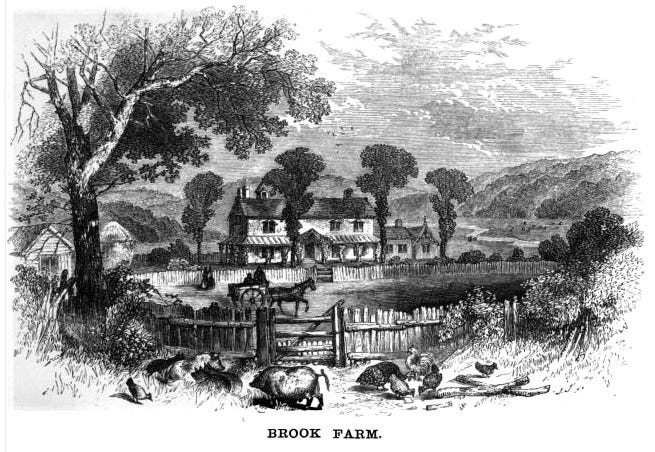
Brook Farm, uma comuna socialista experimental no estado de Massachusetts na década de 1840
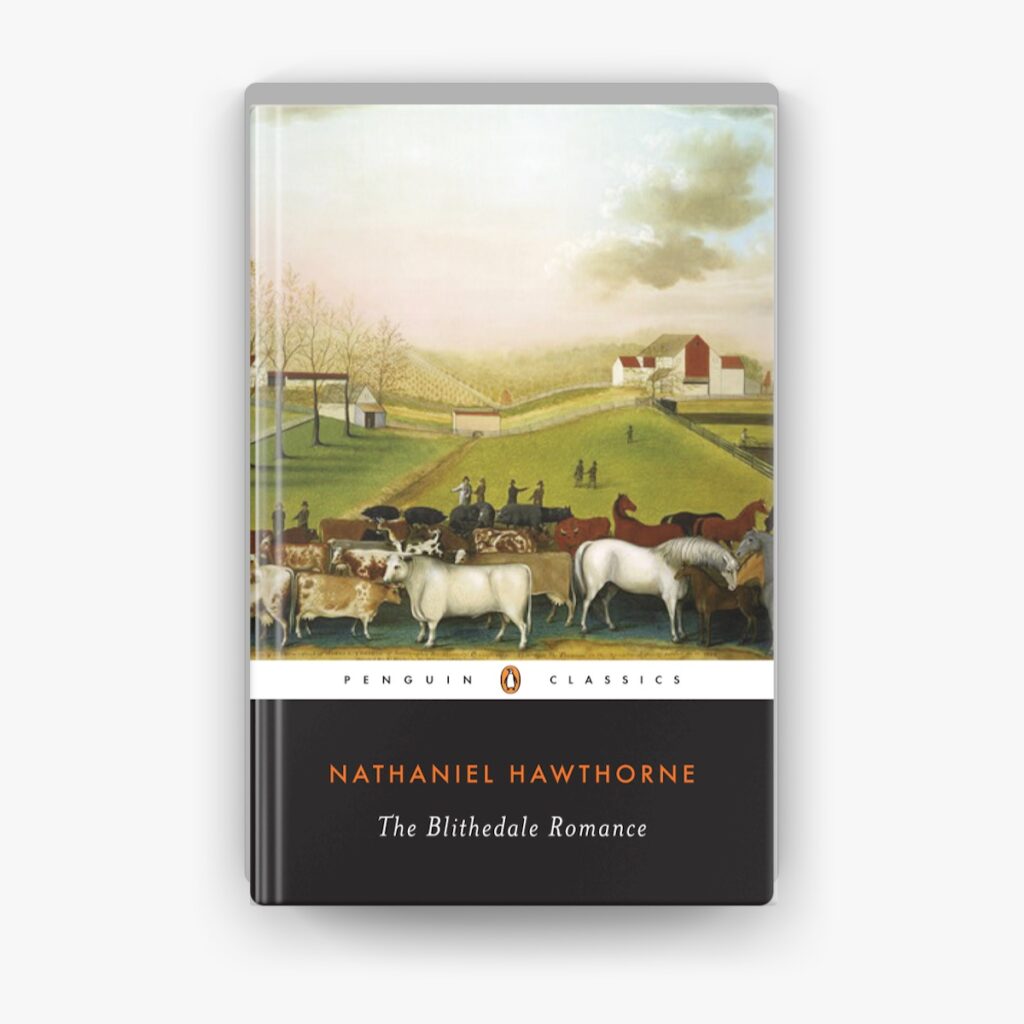
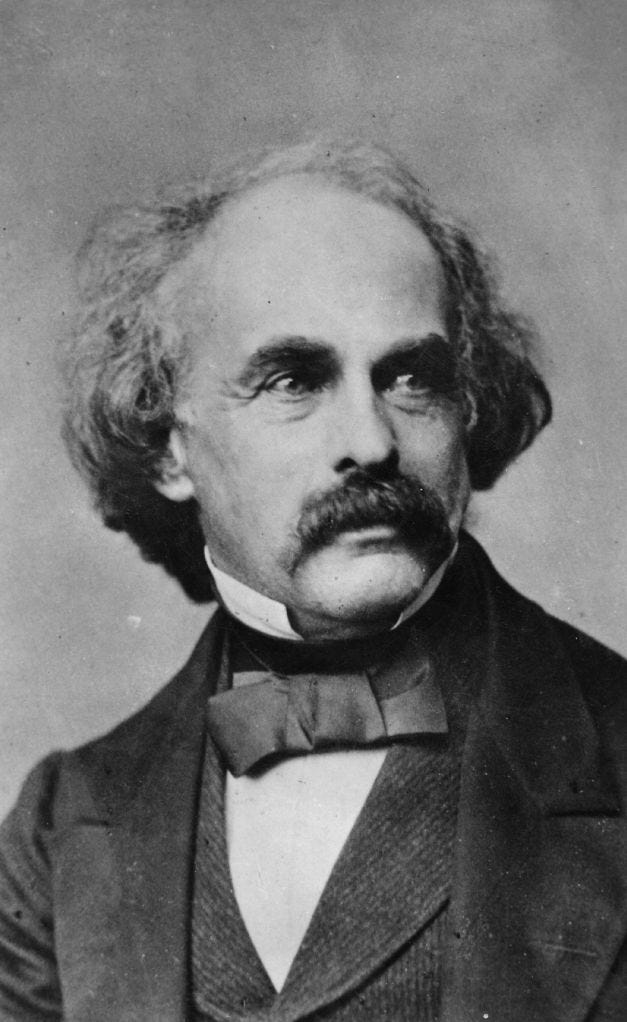
Em 1841, Hawthorne mudou-se para Brook Farm , uma comunidade socialista experimental em Massachusetts. Essa comuna rural utópica, ligada ao movimento transcendentalista , inspirava-se nas ideias de Ralph Waldo Emerson e Charles Fourier , entre outros. Hawthorne passou seis meses lá, vivenciando em primeira mão essa tentativa de construir uma sociedade alternativa. Dez anos depois, em 1851, após ter publicado A Letra Escarlate (1850) e A Casa das Sete Torres (1851), Hawthorne finalmente pegou na caneta e escreveu O Romance de Blithedale, um livro que nasceu da experiência em Brook Farm. Não se trata de uma celebração de triunfo: “Brook Farm deixou de existir”, explica Annette Kolodny em sua introdução à edição da Penguin Classics. “Dificuldades financeiras a assolaram desde o início e, após um incêndio devastador em 1846, todo o experimento foi abandonado na primavera de 1847.”
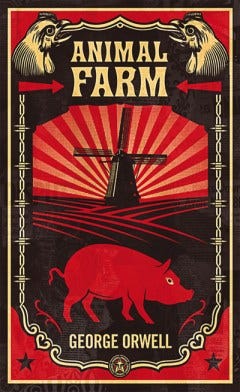
Embora Hawthorne tente revelar por que o experimento falhou, ele escreve sobre isso sem sarcasmo amargo nem diminui seu valor. Esta não é uma sátira como A Revolução dos Bichos, de George Orwell, uma fábula mordaz sobre o stalinismo na União Soviética. O Romance de Blithedale não busca demolir e ridicularizar criticamente o experimento de Brook Farm. Nas primeiras páginas do livro, podemos sentir como o autor descreve com carinho o heroísmo daqueles ao seu redor, que haviam abandonado uma vida de conforto e indolência para se dedicarem a uma experiência coletiva que visava à renovação da sociedade humana. Há mais do que algumas gotas de Romantismo em suas descrições iniciais da fazenda Blithedale:
“Se alguma vez os homens puderam sonhar acordados e expressar suas visões mais amplas, sem temer o riso ou o desprezo da plateia – sim, e falar da felicidade terrena, para si mesmos e para a humanidade, como um objetivo a ser almejado e provavelmente alcançado – nós, que formamos aquele pequeno semicírculo ao redor da fogueira, éramos esses homens. Tínhamos deixado para trás a estrutura de ferro enferrujada da sociedade. Tínhamos rompido muitos obstáculos poderosos o suficiente para manter a maioria das pessoas na cansativa esteira do sistema estabelecido, mesmo sentindo seu incômodo quase tão intolerável quanto nós. Tínhamos descido do púlpito; tínhamos jogado a caneta de lado; tínhamos fechado o livro-razão; tínhamos nos livrado daquela doce, encantadora e debilitante indolência, que, afinal, é melhor do que a maioria dos prazeres ao alcance mortal. Nosso propósito – generoso, certamente, e absurdo, sem dúvida, em plena proporção à sua generosidade – era renunciar a tudo o que tínhamos até então alcançado, com o objetivo de mostrar à humanidade o exemplo de uma vida regida por princípios diferentes dos falsos e cruéis nos quais a sociedade humana sempre se baseou.” (p. 19)
No livro de Hawthorne, Brook Farm aparece como um lugar isolado, em mais de um sentido: fica longe da cidade e de seu ar poluído, mas também está desconectado de outras comunas semelhantes. No entanto, como afirma Kolodny, nesse momento histórico – as duas décadas que antecederam a Guerra Civil – houve uma “proliferação de comunidades socialistas experimentais e um ativismo público cada vez mais organizado, voltado para a correção de uma série de males sociais percebidos”.
KOLODNY – O grande pânico financeiro de 1837 fechou bancos, cortou o crédito e fez com que muitos pequenos agricultores perdessem suas terras. Na depressão subsequente, que durou até a década de 1840, (…) a população rural recém-desapossada migrou para as cidades e vilas industriais, juntando-se aos imigrantes europeus recém-chegados para formar uma subclasse de pobres urbanos. Na década de 1840, a cena de crianças pequenas mendigando nas ruas dos principais centros urbanos já não era incomum. Ao mesmo tempo, uma industrialização em rápido desenvolvimento, possibilitada por uma tecnologia forjada a vapor e ferro, estava mudando a face do que antes fora uma nação assumidamente agrária. Embora a maior parte da população permanecesse no campo, na década de 1840 já se observava um movimento centrípeto demonstrável em direção à cidade e à fábrica. Apesar de a imagem ter sido em grande parte uma ilusão, a autoimagem da nação como uma terra de pequenos agricultores independentes estava sendo rapidamente corroída pela realidade de uma economia de mercado implacável e pela exploração dos assalariados. trabalhadores nas cidades e cidades fabris.
Em resposta, os americanos foram tomados por uma onda de antiurbanismo que durou até a véspera da Guerra Civil. A acumulação sem precedentes de capital nas mãos de poucos poderosos, a nova tecnologia, os cortiços urbanos, as cidades fabris superlotadas e as instituições públicas insensíveis foram todos apontados como as causas da pobreza urbana, do aumento da criminalidade e da decadência moral generalizada. Sociedades privadas e organizações filantrópicas surgiram para tentar a reabilitação de criminosos, a proteção de prostitutas e o cuidado de órfãos e indigentes – embora nenhum grupo tivesse recursos suficientes para a tarefa. Aqueles que perderam a esperança em tais medidas paliativas assumiram tarefas mais ambiciosas para a reforma da sociedade. Em todo o país, comunidades independentes – geralmente organizadas em torno da agricultura em vez da indústria – foram formadas de acordo com vários projetos idealistas de harmonia social e econômica. Brook Farm foi apenas um desses experimentos.” (KOLODNY – XII)
Em “Romance de Blithedale”, Hawthorne não pinta um retrato sociológico de sua época . “As Vinhas da Ira”, de John Steinbeck , por exemplo, mergulha muito mais profundamente no contexto da Grande Depressão da década de 1930 do que Hawthorne no Pânico de 1837 , a crise que antecedeu a Guerra Civil Americana. Pode-se dizer que Hawthorne escreve magnificamente sobre indivíduos, mas apenas esboça as características das sociedades. Ele é um mestre em explorar os segredos mais íntimos do coração humano e em retratar as relações humanas em toda a sua complexidade de sentimentos, mas não pude deixar de sentir que ” Romance de Blithedale” poderia ser uma obra de arte mais impressionante se o autor tivesse se concentrado um pouco mais na análise sociológica. Às vezes, parece que ele está debatendo doutrinas do século XIX , como a de Fourier, geralmente rotulada como Socialismo Utópico – mas o leitor mal obtém informações sobre as características gerais da sociedade ideal de Fourier. Fourier parece muito mais um saco de pancadas para Hawthorne desferir contra um “idealista” que ele parece desprezar. O mesmo acontece com o personagem de Hollingsworth, o filantropo , que é descrito pelo narrador, Miles Coverdale, em várias partes do livro, com certo desprezo e ceticismo. Isso me lembrou um pouco a atitude irônica de Lars Von Trier em relação a Thomas Edison Jr. em Dogville.
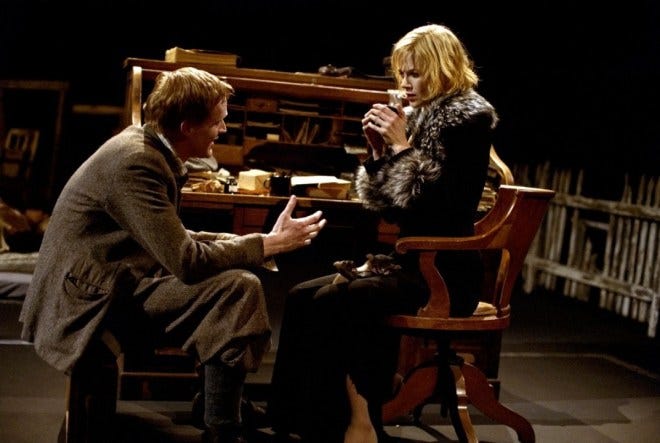
Uma cena do filme “Dogville”, de Lars Von Trier: algo na relação entre Tomas Edison Jr. e Grace lembra as moradas de Zenobia e Holdsworth, de Hawthorne.
Embora Coverdale encontre muito o que admirar e valorizar em Hollingsworth, ele também é descrito como alguém que foi vítima de
“Uma peculiaridade severa e terrível, que não poderia deixar de ser perniciosa para a felicidade daqueles que se envolvessem intimamente demais com ele. (…) Isso sempre se aplica aos homens que se entregaram a um propósito dominante. Ele não os impulsiona de fora, nem mesmo opera como uma força motriz interna, mas se incorpora a tudo o que pensam e sentem, e finalmente os converte em pouco mais do que esse princípio. Quando essa situação começa a se apresentar, não é covardia, mas sabedoria, evitar essas vítimas. Elas não têm coração, nem compaixão, nem razão, nem consciência. Não manterão nenhum amigo, a menos que ele se torne o espelho de seus propósitos; irão golpeá-lo e matá-lo, e pisotear seu cadáver, com muito mais facilidade, se você der o primeiro passo com elas e não puder dar o segundo, e o terceiro, e todos os outros passos de seu caminho terrivelmente reto.” (p. 70)
Nietzsche costumava descrever o fanatismo como uma espécie de doença psíquica que leva sua vítima a transformar um ponto de vista específico (entre milhares de perspectivas possíveis ) em algo absoluto. Hollingsworth parece uma figura fanática, totalmente devotada ao seu projeto de regenerar criminosos e determinada a seguir seu caminho reto com obstinada inflexibilidade. Coverdale, o narrador em primeira pessoa de ” The Blithedale Romance”, consegue enxergar através da máscara do filantropo e descobre em seu âmago um egoísmo monstruoso. Ao escrever sobre pessoas como Hollingsworth, ele afirma:
“Eles têm um ídolo, ao qual se consagram sumos sacerdotes, e consideram sagrado oferecer sacrifícios de tudo o que lhes é mais precioso, e jamais parecem suspeitar – tão astuto tem sido o Diabo com eles – que essa falsa divindade, em cujos traços de ferro, impassíveis para toda a humanidade, eles veem apenas benignidade e amor, nada mais é do que um reflexo do próprio sacerdote, projetado na escuridão circundante. E quanto mais elevado e puro for o objeto original, e quanto mais altruisticamente ele tiver sido adotado, menor será a probabilidade de que eles reconheçam o processo pelo qual a benevolência divina foi degradada em egoísmo devorador.” (p. 71)
Duas mulheres – que o leitor só descobre serem irmãs ao longo de alguns capítulos – também são o foco da obra de Hawthorne: Zenobia e Priscilla. Elas são filhas do Sr. Moody em diferentes épocas de sua vida: Zenobia, filha do triunfo e da riqueza; Priscilla, filha da decadência e da pobreza. Essas duas irmãs se reencontram na Fazenda Blithedale: a frágil Priscilla buscando refúgio e consolo no seio da poderosa e majestosa Zenobia. Pesquisadores e estudiosos apontaram que Hawthorne baseou Zenobia em uma figura real, Margaret Fuller , uma “ defensora dos direitos das mulheres associada ao movimento transcendentalista americano . Ela foi a primeira mulher americana a se dedicar integralmente à crítica literária. Seu livro Mulher no Século XIX é considerado a primeira grande obra feminista nos Estados Unidos.” (Wikipedia) As palavras de Hawthorne ao descrevê-la são magníficas, repletas de poesia e admiração, e ele consegue pintar um retrato quase shakespeariano dessa mulher, parte Cleópatra, parte Ofélia.
“De fato, tão grande era seu poder e influência inatos, e tão grande parecia a pureza despreocupada de sua natureza, que tudo o que Zenóbia fazia era geralmente reconhecido como correto. O mundo nunca a criticou tão duramente quanto critica a maioria das mulheres que transcendem suas regras. Quase cedeu ao vê-la trilhar um caminho diferente do comum e reivindicar os privilégios mais amplos de seu sexo, tanto na teoria quanto na prática. A esfera da feminilidade comum era considerada mais restrita do que seu desenvolvimento exigia.” (p. 190)
Hawthorne possui um talento excepcional para criar personagens femininas inesquecíveis, como Hester Prynne, de “A Letra Escarlate” , e com Zenobia ele faz um trabalho incrível também. As mulheres de Hawthorne têm tantas dimensões, e seus corações são tão labirínticos e complexos, que ele parece ampliar os horizontes da feminilidade. Hawthorne é um escritor com uma capacidade incomum de abraçar a condição humana. E sua representação de Zenobia demonstra a enorme empatia entre o autor e sua personagem. Zenobia também é um reflexo da época: na década de 1840, a América do Norte testemunhava a ascensão do feminismo, como lembra Annette Kolodny.
“A convergência do clima político acirrado das décadas que antecederam a Guerra Civil foi intensificada pela crescente agitação em nome dos dois maiores grupos marginalizados do país: negros e mulheres. A primeira convenção pelos direitos das mulheres foi realizada em Seneca Falls, Nova York, em 1848. E, num último esforço para apaziguar os secessionistas do sul, o Congresso aprovou o notório Compromisso de 1850, com sua lei de escravos fugitivos mais severa. Cada vez mais, ativistas antiescravistas e defensoras dos direitos das mulheres faziam valer o bom senso, exigindo que a nação fizesse jus às suas pretensões democráticas.” (XII)
Na América de Hawthorne, a escravidão e a condição da mulher ainda eram espinhos no chamado Sonho Americano, que essas comunidades de vida alternativa lutavam para reconstruir em outras bases, mais respeitosas com a dignidade de todos os seres humanos e visando reverter instituições baseadas na opressão, no trabalho forçado e na misoginia. Zenobia, a heroína de “O Romance de Blithedale” , é descrita como uma pessoa de coração generoso, transbordando vida. Ela tem o dom de cativar os ouvintes quando sobe ao palco, como uma atriz shakespeariana, e encanta a plateia com histórias maravilhosas (como a história da Dama Velada). Zenobia, embora pareça independente e nunca aja com servilismo, cai no magnetismo dos Hollingsworth. O filantropo e Zenobia são vistos caminhando de mãos dadas, sussurrando palavras que o narrador não consegue ouvir, e até planejam construir um ninho onde possam viver juntos. Nessa relação parece residir uma semente de catástrofe que, embora presente desde o início, demora a desabrochar. O que começa como romance termina em tragédia. Zenobia é descrita como alguém que nutria grandes esperanças, mas as viu desmoronar. Ela almejava muito alto e, então, não suportou se ver tão desanimada. Quando as nuvens de sua paixão por Hollingsworth se dissipam, ela o ataca.
“Você é um homem? Não; mas um monstro! Uma peça de mecanismo fria, sem coração, que começa e termina por si mesma! (…) É tudo ego… nada além de ego, ego, ego! (…) Agora eu vejo! Estou desperto, desencantado, desvencilhado! Você se encarnou em um projeto. Você é um mascarado melhor do que as bruxas e ciganos lá longe; pois seu disfarce é autoengano.” (p. 218)
Após o rompimento entre Zenobia e Hollingsworth, parece muito improvável que a Fazenda Blithedale sobreviva. Hawthorne conduz seus personagens em uma jornada da esperança ao desespero, de sonhos idealistas a um despertar rude e doloroso. Ao final do livro, Zenobia está
“Cansada deste lugar e farta de fingir filantropia e progresso. De todas as formas de vida simulada, certamente nos metemos na mais vazia delas, em nosso esforço para estabelecer o único sistema verdadeiro. Acabou para mim; e Blithedale precisa encontrar outra mulher para supervisionar a lavanderia… Foi, de fato, um sonho tolo! Contudo, nos proporcionou alguns dias agradáveis de verão e esperanças brilhantes, enquanto duraram. Não pode fazer mais nada; nem nos adiantará derramar lágrimas por uma bolha estourada.” (p. 227)
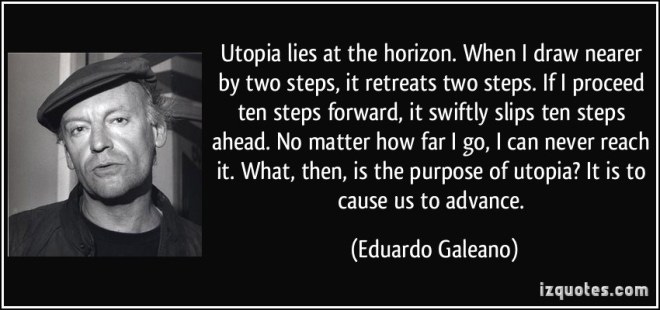
As dificuldades são enormes no caminho daqueles que tentam construir uma sociedade melhor, e grandes esperanças podem, por vezes, levar a um desespero terrível. Eu não diria que o livro de Hawthorne joga baldes de água gelada nos corações ardentes dos revolucionários e de outras pessoas dedicadas à mudança social; ele apenas conta uma história, magnificamente contada, que deixa claro quão complexo e intrincado é o esforço para dar vida a uma utopia. Ela nunca parece ser construída na realidade com todas as perfeições que possuía quando era apenas um sonho, um projeto no mundo fantasma da mente. Seria este um motivo para abandonar todos os sonhos utópicos e simplesmente nos conformarmos com o que é? Não, segundo o grande escritor uruguaio Eduardo Galeano: ele afirma que a cada passo que damos para a frente, a utopia dá dez passos para trás, como se estivesse fugindo de nós. Não importa quantos passos demos em sua direção, a utopia está sempre recuando e não conseguimos compreendê-la completamente. Não conseguimos torná-la real. Isso significa que ela é inútil? Não, diz Galeano: esse mundo melhorado em nosso horizonte tem um objetivo muito importante, que é justamente fornecer um motivo para nossos passos. Como se nos puxasse de horizontes distantes, ou como se fôssemos impulsionados a encontrá-lo em algum dia futuro que é constantemente adiado.
“…de pé junto ao túmulo de Zenóbia, nunca mais o vi, mas não tenho dúvida de que a relva cresceu ainda mais viçosa naquele pequeno paralelogramo de pasto, por causa da decomposição da bela mulher que ali repousava. Como a Natureza parece nos amar! E como, no entanto, prontamente, sem um suspiro ou queixa, ela nos converte a um propósito inferior, quando o seu mais elevado – o da vida consciente, intelectual e sensível – é prematuramente interrompido! Enquanto Zenóbia viveu, a Natureza se orgulhava dela e direcionava todos os olhares para aquela presença radiante, como sua mais bela obra. Zenóbia pereceu. A Natureza não derramará uma lágrima? Ah, não! Ela adota a calamidade imediatamente em seu sistema e fica tão satisfeita, pelo que podemos ver, com o tufo de vegetação mais densa que brotou do coração de Zenóbia, quanto com toda a beleza que não nos legou nenhum representante terreno, exceto nesta plantação de ervas daninhas. É porque o espírito é inestimável que o corpo sem vida é tão pouco valorizado.”
NATHANIEL HAWTHORNE, O Romance de Blithedale
****
ORIGINAL
Utopia’s dangers and toils: some remarks on Hawthorne’s “The Blithedale Romance” (1852)
In 1841, Hawthorne moved to Brook Farm, an experimental socialist community in Massachussets. This Utopian rural commune, connected with the Transcendentalism movement, drew inspiration from the ideas of Ralph Waldo Emerson and Charles Fourier, among others. Hawthorne spent six months there, experiencing first-hand this attempt to build an alternative society. Ten years later, in 1851, after he had published The Scarlet Letter (1850) and The House of The Seven Gables (1851), Hawthorne finally put pen to paper and wrote The Blithedale Romance, a book born out of the Brook Farm experience. It’s not a celebration of triumph: “Brook Farm was no more”, explains Annette Kolodny in her introdution’s to the Penguin Classic’s edition. “Financial difficulties had plagued it from its inception and, after a devastating fire in 1846, the entire experiment was abandoned in the spring of 1847.”
animalfarmEven tough Hawthorne tries to reveal why the experiment failed, he writes about it with no bitter sarcasm nor diminishing its value. This is not a satire like George Orwell’s Animal Farm, a viperish tale about Stalinism in the Soviet Union. The Blithedate Romance isn’t trying to critically demolish and ridicule the Brook Farm experiment. In the first pages of the book we can feel how the author affectionaly describes the heroism of those around him, who had turned their backs to a life of confort and indolence, and were now devoted to a collective experience which aimed at the renovation of human society. There’s more than a bunch of drops of Romanticism in his earlier descriptions of the Blithedale farm:
“If ever men might lawfully dream awake, and give utterance to their widest visions, without dread of laughter or scorn on the part of the audience – yes, and speak of earthly happiness, for themselves and mankind, as an object to be hopefully striven for, and probably attained – we, who made that little semi-circle round the blazing fire, were those very men. We had left the rusty iron frame-work of society behind us. We had broken through many hindrances that are powerful enough to keep most people on the weary tread-mill of the established system, even while they feel its irksomeness almost as intolerable as we did. We had stept down from the pulpit; we had flung aside the pen; we had shut up the ledger; we had thrown off that sweet, bewitching, enervating indolence, which is better, after all, than most of the enjoyments within mortal grasp. It was our purpose – a generous one, certainly, and absurd, no doubt, in full proportion with its generosity – to give up whatever we had heretofore attained, for the sake of showing manking the example of a life governed by other than the false and cruel principles, on which human society has all along been based.” (p. 19)
In Hawthorne’s book, Brook Farm appears as an isolated place, in more than one sense: it’s far away from the city and its polluted air, but it’s also disconnected from other similar communes. But, as Kolodny states, in this historical moment – the two decades preceding the Civil War – there was a “proliferation of experimental socialist communities and increasingly organized public activism directed at correcting a host of perceived social ills”:
“The great financial Panic of 1837 had shut banks, closed off credit, and caused many smaller farmers to lose their holdings. In the ensuing depression, which lasted into the 1840s, (…) newly dispossessed rural population moved into cities and factory towns, joining there with recently arrived European immigrants to form an underclass of urban poor. By the 1840s, the sight of small children begging on the streets of major urban centers was no longer unusual. At the same time, a rapidly developing industrialization made possible by a technology forged of steam and iron was changing the face of what had formerly been a self-consciously agrarian nation. While the bulk of the population remained on the land, by the 1840s there was a demonstrable centripetal movement toward the town, the city, and the factory. Although the image had largely been an ilussion, the nation’s image of itself as a land of independent yeoman farmers was quickly being eroded by the reality of a ruthless market economy and the exploitation of wage laborers in the cities and factory towns.
In response, Americans were gripped by a wave of anti-urbanism that lasted until the eve of the Civil War. The unprecedented accumulation of capital in the hands of a powerful few, the new technology, city tenements, overcrowded factory towns, and callous public institutions were all blamed as the causes of urban poverty, increased crime, and general moral decay. Private societies and philanthropic organizations sprang up to attempt the rehabilitation of criminals, the protection of prostitutes, and the care of orphans and paupers – though no group had resources adequate to the task. Those who despaired of such ameliorative measures took upon themselves more ambitious tasks for the reformation of society. All across the country, independent communities – generally organized around agriculture rather than manufacturing – were formed according to various idealistic blueprints for social and economic harmony. Brook Farm was only one such experiment.” (XII)
Hawthorne doesn’t paint a sociological picture of his epoch in The Blithedale Romance. John Steinbeck’s Grapes of Wrath, for instance, delves much more deeply into the context of the 1930’s Great Depression than Hawthorne does about the 1837 Panic, the crisis in the years preceding the outbreak of the Civil War. It may be said that Hawthorne writes magnificently about individuals, but only outsketches the traits of societies. He’s a master when delving into the inner secrets of the human heart, and when depicting human relations in all its complexities of feeling, but I couldn’t help but feel that Blithedale Romance could be a more impressive work-of-art if the author had focused a little bit more on sociological insight. Sometimes it seems he’s engaging in a debate with those 19th century doctrines, like that of Fourier, usually labeled Utopic Socialism – but the reader barely gets any information about the general characteristics of Fourier’s ideal society. Fourier seems much more like a punching-bag for Hawthorne to punch an “idealist” he seems to despise. This is also the case in the character of Hollingsworth, the philanthopist, who is described by the narrator, Miles Coverdale, in many portions of the book, with some scorn and scepticism. It reminded me a little bit of the ironic attitude of Lars Von Trier’s Dogville towards Thomas Edison Jr.
A scene of Lars Von Trier’s film “Dogville”: something in the Tomas Edison Jr. and Grace’s relationship resembles the dwellings of Hawthorne’s Zenobia and Holdsworth
Even though Coverdale finds a lot to admire and cherish in Hollingsworth, he’s also descibed as someone who was a victim of
“a stern and dreaful peculiarity, such as could not prove otherwise than pernicious to the happiness of those who should be drawn into too intimate a connection with him. (…) This is always true of those men who have surrendered themselves to an over-ruling purpose. It does not so much impel them from without, nor even operate as a motive power within, but grows incorporate with all that they think and feel, and finally converts them into little else save that one principle. When such begins to be the predicament, it is not cowardice, but wisdom, to avoid these victims. They have no heart, no sympathy, no reason, no conscience. They will keep no friend, unless he make himself the mirror of their purpose; they will smite and slay you, and trample your dead corpse under foot, all the more readily, if you take the first step with them, and cannot take the second, and the third, and every other step of their terribly straight path.” (pg. 70)
Nietzsche used to describe fanaticism as some kind of psychic disease that causes its victim to transform one particular point-of-view (among thousands of possible perspectives) in an absolute. Hollingsworth seems like a fanatical figure, wholly devoted to his project of regenerating criminals, and bound to follow his straight path with stubborn inflexibility. Coverdale, the first-person narrator of The Blithedale Romance, kind of sees through the mask of the philanthropist and discovers in his inner core a monstruous egotism. When writing about people like Hollingsworth, he claims:
“They have an idol, to which they consecrate themselves high-priest, and deem it holy work to offer sacrifices of whatever is most precious, and never once seem to suspect – so cunning has the Devil been with them – that this false deity, in whose iron features, immitigable to all the rest of mankind, they see only benignity and love, is but a spectrum of the very priest himself, projected upon the surrounding darkness. And the higher and purer the original object, and the more unselfishly it may have been taken up, the slighter is the probabily that they can be led to recognize the process, by which godlike benevolence has been debased into all-devouring egotism.” (pg. 71)
Two women – that it takes the reader some chapters to discover are sisters – are also focused by Hawthorne’s ouevre: Zenobia and Priscilla. They are the daughters of Mr. Moody in different epochs of his life: Zenobia, a daughter of triumph and wealth; Priscilla, a daughter of decadence and poverty. These two sister reunite at Blithedale Farm: the fragile Priscilla seeking refuge and solace in the bosom of the queen-like powerfulness of Zenobia. Researches and scholars have pointed out that Hawthorne based Zenobia on a real-life figure, Margaret Fuller, a “women’s rights advocate associated with the American transcendentalism movement. She was the first full-time American female book reviewer in journalism. Her book Woman in the Nineteenth Century is considered the first major feminist work in the United States.” (Wikipedia) Hawthorne’s words in describing her are magnificent, full of poetry and admiration, and he suceeds in painting an almost Shakespearean portrait of this woman, part Cleopatra, part Ophelia.
“In fact, so great was her native power and influence, and such seemed the careless purity of her nature, that whatever Zenobia did was generally acknowledged as right for her to do. The world never criticised her so harshly as it does most women who transcend its rules. It almost yielded its assent, when it beheld her stepping out of the common path, and asserting the more extensive privileges of her sex, both theoretically and by her practise. The sphere of ordinary womanhood was felt to be narrower than her development required.” (p. 190)
Hawthorne has a great talent for creating unforgettable female characters, such as The Scarlet Letters’ Hester Prynne, and with Zenobia he does an amazing job also. Hawthorne’s women have some many dimensions, and their hearts are so maze-like and complex, that he seems to broaden the horizons of womanhood. Hawthorne’s is a writer with an unusual power to embrace the human condition. And he’s portrayal of Zenobia shows how much empathy has between the author and its creature. Zenobia is also a sign of the times: in the 1840s, North America was witnessing the rise of Feminism, as Annette Kolodny recalls:
“Adding to the feverish political pitch of the decades preceding the Civil War was the increasing agitation on behalf of the country’s two largest disenfranchised groups: blacks and women. The first women’s rights convention was held at Seneca Falls, New York, in 1848. And, in a last-ditch effort to placate southern secessionists, Congress passed the notorious Compromise of 1850, with its more severe fugitive slave act. Increasingly, antislavery activists and women’s rights advocates made common sense, demanding that the nation live up to its democratic pretensions.” (XII)
In Hawthorne’s America, slavery and the condition of womanhood were still thorns in the so-called American Dream, which this alternative-life communes were struggling to re-build in other basis, more respectful of the dignity of all human beings, and aiming to revert institutions based on opression, forced labor, and misogyny. Zenobia, the hero of The Blithedale Romance, is described as a generous heart, bursting with life. She has the gift of entrancing listeners when she goes on to the stage, like an Shakespearean actress, and enthralls the audience with marvelous tales (such as The Veiled Lady story). Zenobia, tough she seems independent and never acts with servility, falls in the Hollingsworth’s magnetic field. The philanthropist and Zenobia are seem walking hand in hand, whispering to themselves words that the narrator can’t hear, and they even plan to build a nest where to live together. In this relationship seems to lie a seed of catastrophe that, even tough is there right from the start, takes a while to blossom. What starts as romance ends in tragedy. Zenobia is described as someone who had nurtured high hopes, but saw them crumbling down. She aimed really high, and then couln’t stand to discover herself so low. When the clouds of her passion for Hollingsworth are blown away, she attacks him:
“Are you a man? No; but a monster! A cold, heartless, self-beginning and self-ending piece of mechanism! (…) It is all self… nothing but self, self, self! (…) I see it now! I am awake, disenchanted, disenthralled! You have embodied yourself in a project. You are a better masquerader than the witches and gipsies yonder; for your disguise is self-deception.” (p. 218)
After this break-up between Zenobia and Hollingsworth, it seems very unlikely that Blithedale Farm will live on. Hawthorne takes his characters in a journey from hope to despair, from idealistic dreams to rude sorrowful awakening. By the end of the book, Zenobia is
“weary of this place, and sick to death of playing at philanthropy and progress. Of all varieties of mock-life, we have surely blundered into the very emptiest mockery, in our effort to establish the one true system. I have done with it; and Blithedale must find another woman to superintend the laundry… It was, indeed, a foolish dream! Yet it gave us some pleasant summer days, and bright hopes, while they lasted. It can do no more; nor it will avail us to shed tears over a broken bubble.” (p. 227)
The difficulties are tremendous on the path of those who try to build a better society, and high hopes may sometime lead to terrible despair. I wouldn’t say Hawthorne’s book throws buckets of freezing water in the burning hearts of revolutionaries and other people devoted to social change; it just tell a story, magnificently told, which makes it clear how complex and intricate is the effort to bring an Utopia to life. It never seems to be built in reality with all the perfections it had when it was but a dream, a project in the Mind’s phantom-land. Is this a reason to abandon all utopian dreams and just accomodate to what is? That’s not the case, according to great Uruguayan writer Eduardo Galeano: he says that each step forward we take, Utopia takes ten steps back, as if it’s running away from us. No matter how many steps in her direction we take, Utopia is always retreating and we can’t fully grasp it. We can’t make it real. Does it mean it’s useless? No, Galeano says: this bettered-world in our horizon has one very important aim, which is exactly providing a motive for our steps. As if it’s pulling us from distant horizons, or as tough we are being propelled to meet it at some Future day that gets constantly postponed.
“…standing by Zenobia’s grave, I have never since beheld it, but make no question that the grass grew all the better, on that little parallelogram of pasture-land, for the decay of the beautiful woman who slept beneath. How much Nature seems to love us! And how readily, nevertheless, without a sigh or a complaint, she converts us to a meaner purpose, when her highest one – that of conscious, intellectual life, and sensibility – has been untimely baulked! While Zenobia lived, Nature was proud of her, and directed all eyes upon that radiant presence, as her fairest handiwork. Zenobia perished. Will not Nature shed a tear? Ah, no! She adopts the calamity at once into her system, and is just as well pleased, for aught we can see, with the tuft of ranker vegetation that grew out of Zenobia’s heart, as with all the beauty which has bequeathed us no earthly representative, except in this crop of weeds. It is because the spirit is inestimable, that the lifeless body is so little valued.”
NATHANIEL HAWTHORNE, The Blithedale Romance
Visualizações da publicação:419
Publicado em: 08/01/26
De autoria: Eduardo Carli de Moraes educarlidemoraes
A Casa de Vidro Ponto de Cultura e Centro de Mídia
Сбербанк-Онлайн pinup casino Nəzərə alın ki, özgə el seçərkən sizdən hesab məlumatlarınızı doldurmağınız aman olunacaq. pinup Rəsmi saytda qeydiyyatdan keçmək üçün zəng edib formanı doldurmağınız kifayətdir. basketbol tennis Oyuncular, Pin Up Qumar'da rahatlıqla oynaya və Pin Up Aviator qədər oyunların keyfini çıxara bilərlər. sürətli qeydiyyat